Robert Malka
Co-Founder and CEO
Two-time founder in education technology and accessibility services. Founded Aufrecht around Andrei Chagin’s growth-plate research.
Children with limb-length discrepancy are treated today with surgery that stops the healthy leg from growing. Aufrecht is developing a drug designed to add growth where it is needed instead. It is the first step toward our long-term goal: limb regeneration.
Aufrecht (OWF-rekht) is German for “upright.”
Illustration, not study data
Around 90% of people have legs of slightly different length, usually by less than a centimeter. Beyond 2 cm, orthopedists broadly agree the difference is a clinical problem, tied to more hip and knee trouble later in life. Here is how it is treated today.
Shoe lift and monitoring
Compensates for the difference. Nothing corrects it.
Stop the healthy leg (epiphysiodesis)
Surgery permanently shuts down a working growth plate in the longer leg. The legs even out only because the healthy leg stops growing.
Aufrecht’s first targetLengthen the short leg surgically
The bone is cut and slowly pulled apart over months, requiring hardware and rehabilitation and carrying a risk of complications.
No approved therapy is designed to grow the shorter leg.
Sources: Gordon & Davis, J Pediatr Orthop 2019; Guichet et al., Clin Orthop Relat Res 1991; Pediatric Orthopaedic Society of North America.
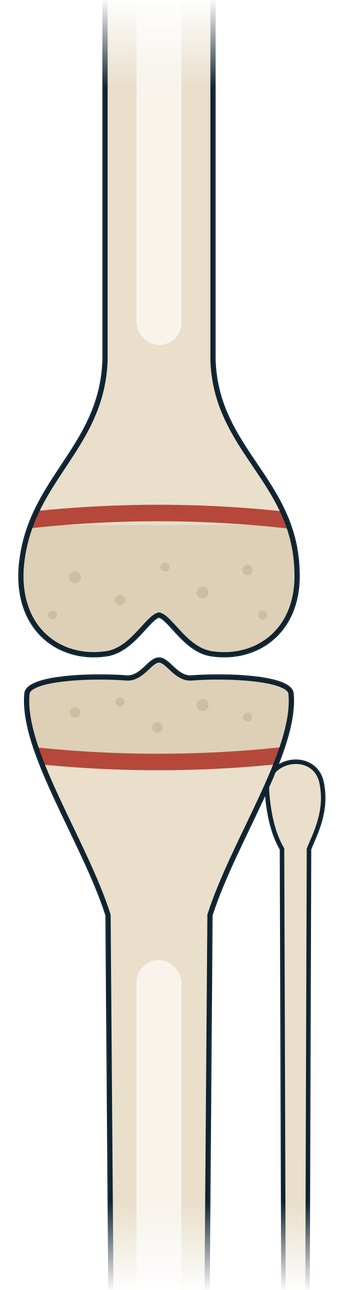
Growth plates are thin layers of cartilage near the ends of long bones. Stem cells in their resting zone produce cells that stack into columns, swell, and are replaced by bone. That is how a child’s leg gets longer, and it is the process our drug is designed to turn up in one leg.
Andrei Chagin’s lab identifies the stem-cell niche that sustains the growth plate.
Newton et al., Nature 2019In juvenile rats, a single local dose of a Hedgehog-pathway agonist leaves the treated leg longer than the untreated one, and still longer six months later.
Trompet et al., JCI Insight 2024The same lab identifies these stem cells in human growth plates, using tissue removed during epiphysiodesis surgery.
Chu et al., Science Translational Medicine 2026A small depot delivers the drug to a chosen growth plate in the shorter leg, rather than through the whole body.
Repeated local doses are intended to add growth at that plate, measured against the untreated leg.
Treatment ends when the legs match. The goal is a correction the child keeps, with the growth plate left intact.
Aufrecht is preclinical. Our current work tests delivery, dose response, and safety in animal models before any study in children.
Any regrown limb has to grow to the right length and then stop. Each program extends that control one step further.
First program, preclinical
Grow the shorter leg in children whose growth plates are still open.
Keep an injured growth plate growing before a bony bar forms.
Organize repair cartilage into a working growth plate.
Long-term goal
Regrow a limb and control its growth to the right size.
Co-Founder and CEO
Two-time founder in education technology and accessibility services. Founded Aufrecht around Andrei Chagin’s growth-plate research.
Scientific Founder
Professor at the University of Gothenburg. His lab identified the growth-plate stem-cell niche and, in 2026, these stem cells in human growth plates. Senior author of the study Aufrecht builds on.

Co-Founder and Head of Science Operations
Translational scientist who has supported five programs to FDA IND clearance and built a translational R&D group. Immunotherapy postdoc at UCLA.
Send a short note. Robert Malka replies directly.